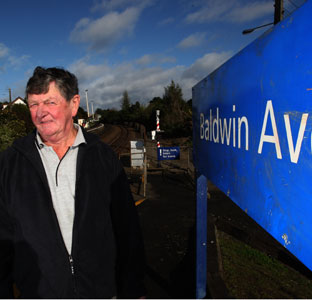
Numbers travelling by bus and train hit 25-year high

No Comments

Lincoln Tan reports in the Herald on recent Auckland public transport patronage figures.

Use of public transport in Auckland has hit a 25-year high, with commuters reporting increased satisfaction with the service on offer.

The Auckland Regional Transport Authority’s annual passenger figures showed 58.6 million trips were made in the year to June 2009 a 7.7 per cent increase on last year and the highest level of public transport use in the city since the mid 1980s. Read the rest of this entry »

Grafton Bridge – bus only?

No Comments

The Central Connector is a critical public transport project providing continuous bus lanes between Britomart and Newmarket. According to Auckland City Council, the project has the following benefits:

The Central Connector forms a crucial part of Auckland’s expanding transport network, linking into the Northern Busway at Britomart and connecting future bus improvement projects on Great South, Manukau and Remuera roads. It will also complement the rail network by providing a travel option to Britomart and Newmarket stations.Work to strengthen and future-proof Grafton Bridge is also nearing completion. The bridge will be able to accommodate heavier low-emission buses and other forms of passenger transport such as light rail in the future.

One crucial aspect of the project has been the strengthening of Grafton Bridge, with the plan to eventually make the bridge bus only from 7am to 7pm on weekdays. The bridge is only two lanes wide, and can only ever be two lanes wide. Therefore, before it was closed for maintenance last year it got very congested at peak hour. Redirecting a lot of buses over Grafton Bridge – as proposed by the Central Connector – would only add to this congestion if other vehicles continued to be allowed to cross the bridge, and undo many of the benefits that the rest of the Central Connector. So, to ensure that the money spent on the Central Connector actually achieves its stated purpose. Council spell this out quite clearly:

Upon completion, the bridge will be able to withstand a one in one-thousand year earthquake and accommodate up to 1200 buses every weekday. Accommodating more buses on the bridge is integral to maximising the benefits of the Central Connector busway and making inner city bus travel faster and more reliable. The bridge will be able to act as an important transport link between Grafton and the CBD, while retaining its heritage glory.

So far, so good. However, it seems as though the road loving politicians that actually make up the Auckland City Council don’t like the idea of not being able to drive across Grafton Bridge whenever they please, and have decided to waste ratepayers’ money and put the whole purpose of the Central Connector at risk, by undertaking further stakeholder and community consultation into whether cars should be banned from the bridge during these hours or not.

My feedback: don’t be idiots. Obviously the bridge has to be buses only from 7am-7pm. Use Wellesley Street bridge like you’ve been doing for the past few months and let’s get on with it. Somewhat fortunately, ARTA’s funding contribution to the project is based on the original proposal – so I hope their feedback goes something along the lines of “it’s buses only from 7am-7pm or you can find somewhere else to get the $14 million we’re contributing!”

Shunted into ’70s

1 Comment
John Landrigan investigates the progress being made on electrification of Auckland’s rail network in this article in the Aucklander.
 
The Government insists that electric rail is still on, dare we say, track. But Auckland is borrowing to buy an ageing diesel fleet of British cast-offs.
 
 All abooooard the great traans-Auckland rail jooourneeey. Bear in mind, folks, there will be many stops before we reach your preferred destinations.
 
 Where do Aucklanders want to go? For more than 80 years Aucklanders have wanted modern, affordable and regular train services to drop them off near work and home.
 
 But plans have been derailed more times than Amy Winehouse has been booked into rehab and left many of us nose-to-tail, alone in our cars, listening to her croon about it.
Under the previous Government, trains were to be modernised, electrified and run underground from Britomart to Mt Eden. This would be paid for through a 9.5 cent regional fuel tax that the Auckland Regional Council championed.
But the new Government abolished regional levies in May, ostensibly to share the burden with the rest of the country through national taxes.
Now, the plan is for the Government to lend the regional council $33 million to help buy six diesel locomotives built in the 1970s, with carriages from British Rail.
To mind the gap until the money can be raised? It would seem so, but at what cost?

No matter how hard The Aucklander tried to find out, no one could tell us how much of our rates was going to subsidise our taxes for this.

Read the rest of this entry »

Clean, Green Shipping

No Comments

Julian Bevis of Maersk New Zealand goes to bat for the shipping industry in this article in the Herald:

Since 2007, more than 100 of our vessels have used super slow steaming and, thanks to our collaboration with engine manufacturers, Maersk’s entire fleet is now capable of sailing at half speed, which yields considerable reductions in fuel consumption and CO2 emissions.

Reducing the speed of a ship substantially reduces the power required. Traditional policy set the minimum engine load at between 40 and 60 per cent.

However, a 2007 study initiated by Maersk showed it was safe to go as low as 10 per cent.

For large container ships such as the Emma Maersk, the ability to select any given speed down to 10 per cent load can save 3500 tonnes of fuel and 10,000 tonnes of CO2 emissions a year.

Oil Supplies Are Running Out Fast

No Comments

Dr Fatih Birol of the widely respected IEA has never been one to shout that the sky is falling.  This warning should be taken very seriously.  From the Herald:

The world is heading for a catastrophic energy crunch that could cripple a global economic recovery because most of the major oil fields in the world have passed their peak production, a leading energy economist has warned.

Higher oil prices brought on by a rapid increase in demand and a stagnation, or even decline, in supply could blow any recovery off course, said Dr Fatih Birol, the chief economist at the respected International Energy Agency (IEA) in Paris, which is charged with the task of assessing future energy supplies by OECD countries.

In an interview with The Independent, Dr Birol said that the public and many governments appeared to be oblivious to the fact that the oil on which modern civilisation depends is running out far faster than previously predicted and that global production is likely to peak in about 10 years – at least a decade earlier than most governments had estimated.

But the first detailed assessment of more than 800 oil fields in the world, covering three quarters of global reserves, has found that most of the biggest fields have already peaked and that the rate of decline in oil production is now running at nearly twice the pace as calculated just two years ago.

IPENZ on Heavy Trucks

No Comments

Tim Davin of the Institute of Professional Engineers comments in today’s Herald:

Who will bear the cost of heavier vehicles? Where will the costs of heavier vehicles fall, and will they improve New Zealand’s productivity?

We really don’t know the answers to these questions as the analysis has not been done…[more]

Quite. IPENZ members consist of 10,000 engineers throughout New Zealand.


Coding by Essential Software | Theme based on N.Design Studio Entries RSS Comments RSS