On Tuesday, it was not only Greater Auckland that presented to the Transport and Infrastructure Delivery Committee on a future harbour crossing, but also the Campaign for Better Transport in conjunction with The Rail Advocacy Institute of New Zealand, represented by Niall Robertson. Being limited to a 10-minute speaking slot and wanting to maximise the amount of material covered in that time in light of the rarity of the invitation to present (this was in fact the first time I had been invited to present to the Transport and Infrastructure Delivery Committee in my eight years as Convenor of the Campaign for Better Transport), we had to provide an overview of our views on a future harbour crossing. This article represents the opportunity to flesh out our thoughts a bit more.
Public transport at present
The Northern Busway has been one of the success stories of Auckland public transport over the last twenty years. In the 2025 calendar year, patronage on the busway routes (NX1/NX2/866) was 7.73 million, and in the calendar year to date, patronage on those routes is up by 7%. This does not represent the entirety of public transport patronage across the Waitemata Harbour either, as it ignores the 82, 95B, 95C, 97B, 97R and other routes, which link Birkdale, Birkenhead, Takapuna and Bayswater with the Auckland Central Business District.
While the Northern Busway has been a brilliant success story, it is likely that any rail-based service to the North Shore would generate an uplift in patronage – to what extent is unknown.
The state of the bridge
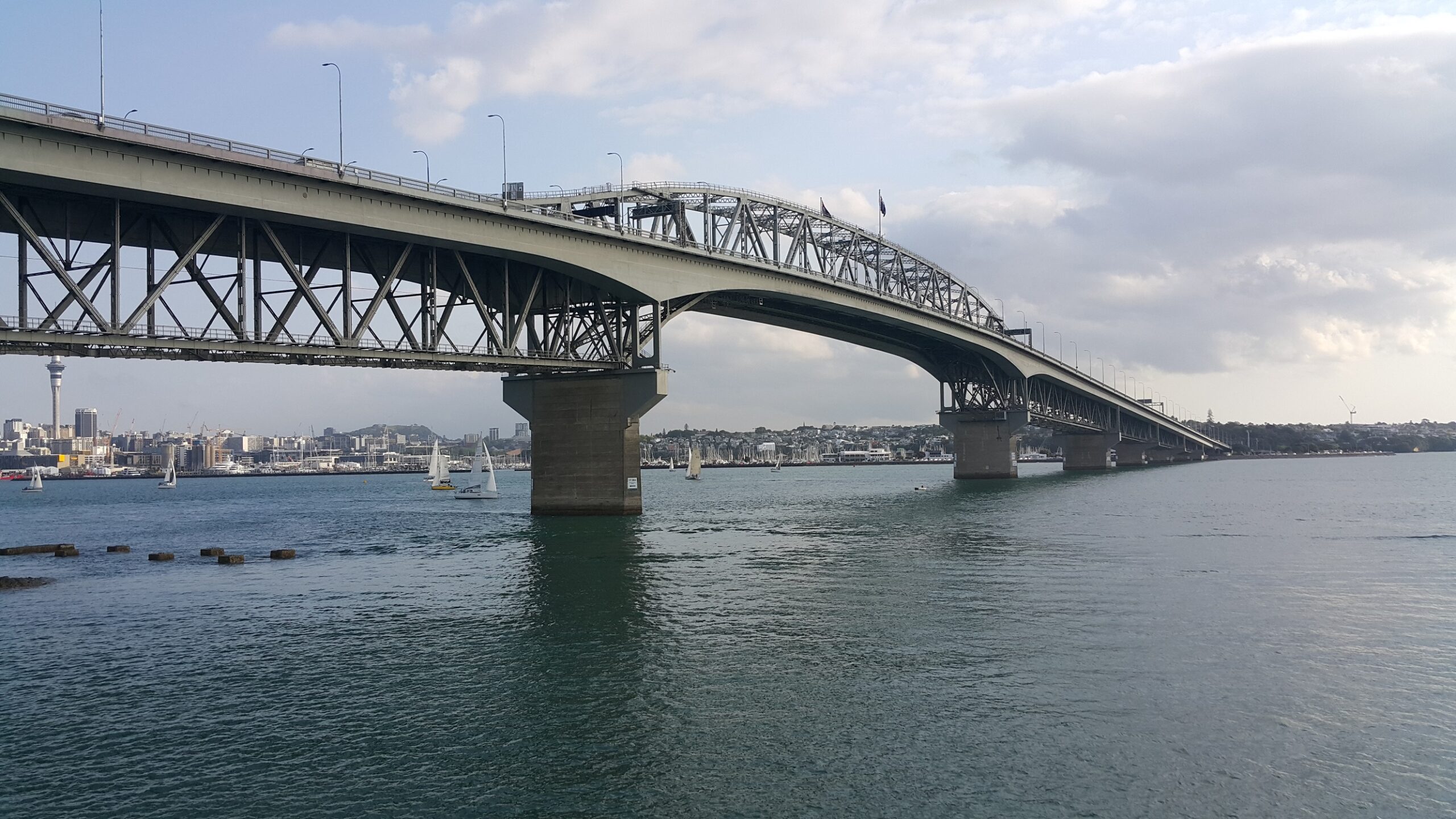
The Auckland Harbour Bridge is starting to show its nearly seventy years of age. Since the 1980s, it has been known that heavy vehicles are a problem for the Auckland Harbour Bridge, particularly the Nippon Clip-ons, and whilst several patchwork jobs have been done to keep the bridge going, it seems inevitable that there will be a ban placed on heavy vehicles at some point. The other problem is that the 2021 experience of a truck striking the girders of the bridge has meant the New Zealand Transport Agency has become paranoid of a repeat experience meaning the bridge is usually closed every time the wind blows.
Light rail resurrected
The discussion around a third harbour crossing has been simmering for some time, and a couple of factors has brought it back to the fore – the government is keen to advance it, whilst the changes to the governance of transport in Auckland means that a thirty year integrated transport plan is in the works to replace the largely forgotten previous Auckland Transport Alignment Plan.
Some wish to take this as an opportunity to resurrect light rail and see light rail to the North Shore. Light rail does have its place in the public transport ecosystem, and we would hope that some of the busier bus routes in Auckland were converted over to light rail. However, we do not think that light rail is suitable for a future Auckland Harbour Crossing. There are several reasons why light rail is not a good idea.
The problem with light rail – capacity
People think light rail offers a significant amount of extra capacity compared with buses thanks to quotation of crush load capacity well into the hundreds. In 2020, the Additional Waitemata Harbour Connections Business Case indicated that light rail would only offer a 40% increase in capacity beyond the existing Northern Busway. Further, crush load capacity well into the hundreds is only possible if coupled vehicles are used, which then begs the question of whether street running would be desirable or not. For example, the Melbourne E class has a design capacity of 200. In the meantime, a double decker bus has seated capacity for around 90 and could potentially accommodate a couple of dozen standees.
The Australian experience is also quite relevant here. In February, the Age did an article which included route by route patronage data on Melbourne’s tram network. This was later expanded by Daniel Bowen into an article (https://danielbowen.com/2026/05/25/australian-tram-patronage-by-route/) which discussed Australian light rail patronage.
The four busiest light rail routes in Australia are the Gold Coast light rail, Melbourne route 96 (the former St. Kilda route), Sydney L2 and Sydney L3. Incidentally, all four of these routes are a true mix of off street and street running, and so would be indicative of what might happen in Auckland if a light rail option were adopted. Each of these routes has around 15 million passengers per annum.
One of the comments in the Daniel Bowen piece was highly informative. With Sydney light rail, traffic light priority had been modelled with two-minute frequencies. Apparently, this modelling had shown traffic light priority with such tight frequencies would cause chaos on east/west routes with delays everywhere, including a significant impact on some of Sydney’s busiest routes. A similar approach had been trialed in Melbourne with route 96 in the early 2010s, with significant impacts on buses heading to Doncaster. All this has meant Sydney light rail is effectively limited to four minute frequencies, and Melbourne route 96 is limited to six minute frequencies.
What does this have to do with Auckland? The NX1 operates to three to five minute frequencies, with NX2 operating to two to three minute frequencies – so already, the Northern Busway operates at a denser operating patterns than the chief light rail routes in Australasia. This pretty much means that if rail to the North Shore were light rail, there would be limited capacity gain.
The problem with light rail – scalability
In 2020, we pointed out that a light rail route from the Auckland Central Business District to Albany would be one of the longer light rail routes in Australasia. If a light rail route ran from the Auckland Central Business District to Silverdale, at 31 kilometres, it would be the longest light rail route in Australasia, even considering the soon opening Stage 3 of the Gold Coast Light Rail.
This essentially means any light rail option is going to be limited to Albany, and possibly Silverdale. The reality is that Warkworth is already starting to grow rapidly thanks to the extension of the Northern Motorway, and if the Northern Motorway is extended further north as the present government desire, then we can conceivably see significant population growth in Wellsford, Mangawhai, Waipu, Ruakaka and Whangarei. Presumably it would be expected these residents travelling to Auckland would either do so by bus to Silverdale before transferring, or they would drive.
On the other hand, a heavy rail option means that should the time come, it would be possible to extend the service beyond Silverdale to a point further north. In the fullness of time, this could see Whangarei enjoying the level of service from Auckland that Newcastle does from Sydney, Nambour does from Brisbane and Bendigo does from Melbourne.
The problem with light rail – speed
One of the problems with light rail is its lack of speed. This is not a problem in a suburban context, but as the distances get longer, it gets more noticeable. The Gold Coast Light Rail is a case in point here – the current end to end trip time is 45 minutes, covering a distance of 20 kilometres. Meanwhile, the NX1 bus travelling from Silverdale to the Auckland Central Business District does the end-to-end trip in 47 minutes – whilst covering a 50% longer distance! The light rail advocates must be dreaming if they think the punters will tolerate a slower trip time, unless the slight of hand that was employed with the Southern Line timetable is taken.
Part of this is because of the speed limit on the vehicles. The Bombardier Flexity 2 (as used in the Gold Coast) or the CAF Urbos 3 (as used in Sydney) have a maximum speed limit of 70 kilometres per hour. Meanwhile, the double decker buses used on the existing Northern Busway generally work to a speed limit of 80 kilometres per hour.
The 24 tonne or so elephant in the room
One of the biggest problems with a proposal floating around is that it would see buses continuing to use the Nippon Clip-ons. It seems that many people have short memories, so let me take the opportunity to remind you that when double-decker buses were first introduced to Auckland, they were legally H trucks and needed to carry the H plates! It shouldn’t take much to realise that letting buses continue to use the Nippon Clip-ons does not solve the problem!
So what is the solution?
The solution is quite simple – another bridge but limited to heavy vehicles (trucks), public transport (buses and rapid/heavy rail) and pedestrians/cyclists. The Railway Advocacy Institute of New Zealand puts it quite simply:
Starting Point: Victoria Park (City Side) (with rail connection from Waitemata via Fanshawe Street)
The current motorway viaduct bends west around Victoria Park. This bridge begins at the corner of the park, where the viaduct almost forms a natural straight-line launch point.
Bridge Path: Direct Line to Northcote
From Victoria Park, the structure continues forward in a straight alignment across the Waitemat?, landing at Sulphur Bay, Northcote, near the current boat ramp This is only around 500 metres longer than the current harbour bridge.
Alternatively it could land further north at Onewa Pt, Northcote adjacent to the current Onewa Point interchange. This second point could allow more favourable grades for rail but could be up to 1500m longer than the current bridge.
Alternative suggestion: Build an elevated dyke along the foreshore from the start of the Esmonde Rd causeway to the harbour bridge as an alternative to raising the Northern Motorway as a climate change measure. Road traffic leaves at Onewa Pt going north, but rail could remain elevated until the Esmonde Rd bus station, then moving to its route relative to the motorway after Esmonde Rd.
The Railway Advocacy Institute of New Zealand suggested that an additional bridge for heavy vehicles, rapid/heavy rail and pedestrians could be done for $9.5 billion, including the construction of the rapid/heavy rail route to Albany and city-side rail works.
And all this is a vastly superior solution. North Shore rapid/heavy rail could be to Auckland what the Mandurah Line has been for Perth (and it is worth noting that route carries more than 23 million passengers per annum!)